
Our Fat Parents
How 90s Diet Culture Effed It All Up

We plucked what we called honeysuckle from the ground and sipped the sweet nectar right from the purple petals into our eager mouths. Nevermind it was probably covered in pesticides. It was the early 90s and I don’t recall anyone caring much about chemicals.
We were kids. Huddled in the outfield of the playground/ball field out by the chain link fence. Far away from the prying ears of teachers we wrongly assumed were real adults and nuns with pencil thin lips and gray hair peeking from beneath their veils.
“My…mom…is…fat…” Sasha stood close to Beth, their bodies turned toward each other and only slightly open toward me. Two girls I considered friends but who maybe didn’t feel the same way about me were swapping shame stories about their mothers. And they were…crying.
I was confused. I’d met their mothers before. Had I noticed they were fat? I guess they kind of were. Then again, didn’t everyone think they were fat in the 90s? Snackwells reigned and God forbid you had full-fat anything, except maybe those Little Debbie snacks you hoarded when you were staying the night with a friend. We were three girls who hadn’t yet hit puberty, but knew it was looming with unknown proportions right around the corner.
My mom wasn’t fat. She wasn’t fit by any means, but I suppose she was thin. I quickly understood that their shame for their mother’s body was fear for their own bodies. Would they, too, be stricken with that dreaded curse of fatness?
“My dad is fat!” I chimed in, desperate to belong to the “Ashamed of Our Fat Parents Club.” It was true. My dad was a large man. Though it was only his belly. His arms and legs were rather slender and he frequently joked that he must be pregnant.
“It’s not the same!” They continued crying, unimpressed by my assertion that my dad was a behemoth and caused me great embarrassment. Only, that part was a lie. I don’t recall being disgusted by my dad’s largesse, but he certainly was…large. He was often the punch line of his own jokes, talking about how he needed a “man bra.” We all laughed. But maybe it wasn’t really funny.
He was once rail thin. I know this because I foolishly wore his Navy uniform to a Halloween party when I was 15 and it fit me like a glove. I was 5’10’ and all of 140 pounds. I’m not sure when his belly started to come on, but I imagine it was during mid-life when most of our bodies just start to do their own damn thing.
He tried so many diets, “Slim Fast” the most enduring. Just the mention of that name and I can feel the chilled can in my hand, the unique texture and wobbly sound it made when squeezed. The thick, saccharine liquid of strawberry, chocolate, or vanilla promised a trim waistline as it slid down your throat.
Even now, I might say, “he stuck with it, and was successful.” But what is successful about starving yourself for a prolonged period of time? I remember the day he asked me to give him a hug, and for the first time in my life, my arms could wrap completely around his waist. He bought new clothes. He was happy. He was proud. But it didn’t last long. Soon he was back to his original size. Or maybe his unoriginal size? I imagine in his mind he was still a fit and trim 25-year-old, now lugging around a frame he didn’t recognize.
At some point, he gave up trying to lose weight. Maybe it was when he watched his 27-year-old son wasting away from anorexia. My brother Eric, 13 years older than me, suffered from severe mental illness, a giant skeleton standing at 6 foot 8. He would wander around our house like a ghost, his white briefs barely hanging onto his hip bones.
My dad quit his day job, and took on work in a night-shift factory so he could cook for his son during the day. My mom had a 30-plus-year career as a teacher, and she held the benefits. It made more sense.
Suddenly, my dad was the best cook. He pored over cookbooks and as the consummate creative, he ended up making recipes of his own. My favorite was what he called “tamale pie.” It was more like a casserole, layers of rice and canned tamales and chili and cheese. Or maybe it was his pecan sticky rolls he made in a muffin pan, the ooey-gooey caramelized pecans nestled in the bottom of each cup, with doughy, yeasty bread bursting over the top.
The food that was once his enemy, was now the thing that would save his son’s life. When you’re watching your child shrink before your eyes, refusing to eat, ridding their body of everything they do manage to consume, you start to re-evaluate your own relationship with food real quick. I would know.
I am now in mid-life. Perhaps the age my father was when his body started to shift and change and expand in the middle with abandon. I have three children of my own. And while I’ve always been aware of how I talk about my own body, the world will tell my children what it wants. I hid our scale, I no longer talk about weight loss, and honestly, I’d like to think I no longer care. After a colitis diagnosis stripped my body of 30 pounds in 6 weeks, I should see my ability to maintain weight as a success.
Mostly, I do. But when my pants are too tight, my belly pops over the top of my jeans, or my cellulite sees daylight, my instincts tell me to tuck it all back in. Hide it away. My body tenses. What I would give to go back and undo all of the shameful body image messaging I’ve absorbed over the years. There was never consideration for what food could do for your body. Only to your body–make it fat.
As if fatness was the worst thing that could happen to your flesh. I assure you I would take the extra 40 pounds I carry now over the shell of myself that carried me through the worst of my colitis. But wait. Why am I calling it “extra?” When that weight is a reflection of exactly what I needed?
I want to be at peace in my body. I have a chronic illness. Several, actually. I know this and yet…I crave more. Always more. More energy. More ability. More good days. More spoons. My expectations are the cause of my distress, and I’m reprimanded by the words of Byron Katie. “I am a lover of what is, not because I'm a spiritual person, but because it hurts when I argue with reality.”
My dad argued with his reality for years. I argue with mine. We call it “self improvement” but it feels like self degradation.
My brother eventually died by suicide. My father died in his sleep, possibly from an accidental overdose (that’s a story for another day). My mom has passed too. Their bodies are gone. My body is still with me. And I am still with my body. Someday, my kids will miss this body of mine. My rolls and wrinkles and large pores and receding hairline and morning breath and pretty eyes and full lips and tender hands. They will miss all of me. They won’t wish I had been in a different body when I was alive. They would gladly take my flawed body back, because it’s where they learned to love my soul. Can I learn to love my soul in this body too?
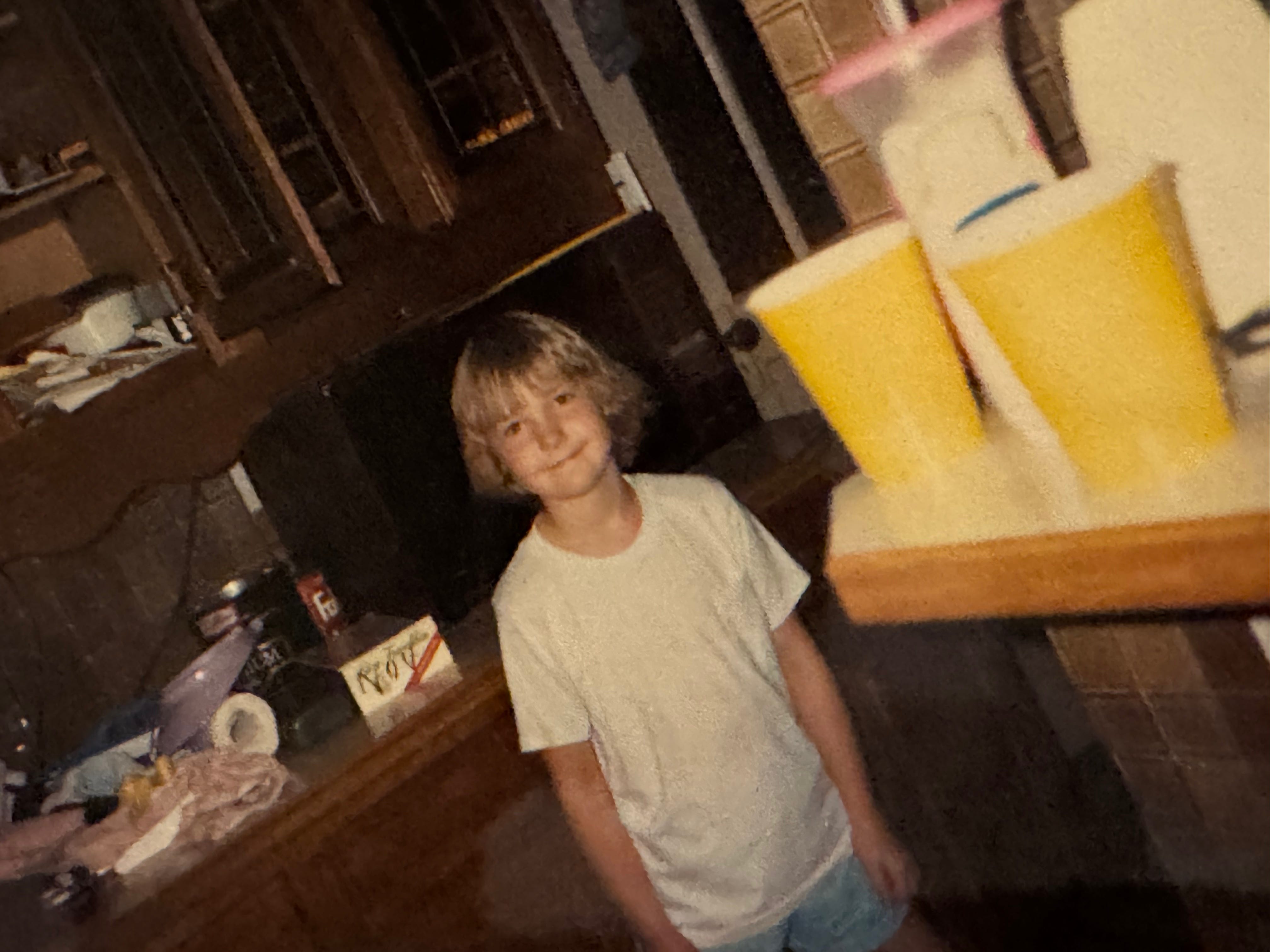
Little me. When my body was still mine. Neutral. Capable of running fast and skinning my knees and building forts and fist fighting with my brother.